Schinkel’s Lehrbuch. A Resilient ‘Form’ of Thought
DOI:
https://doi.org/10.15168/xy.v10i16.3773Keywords:
architecture, drawing, travel writingAbstract
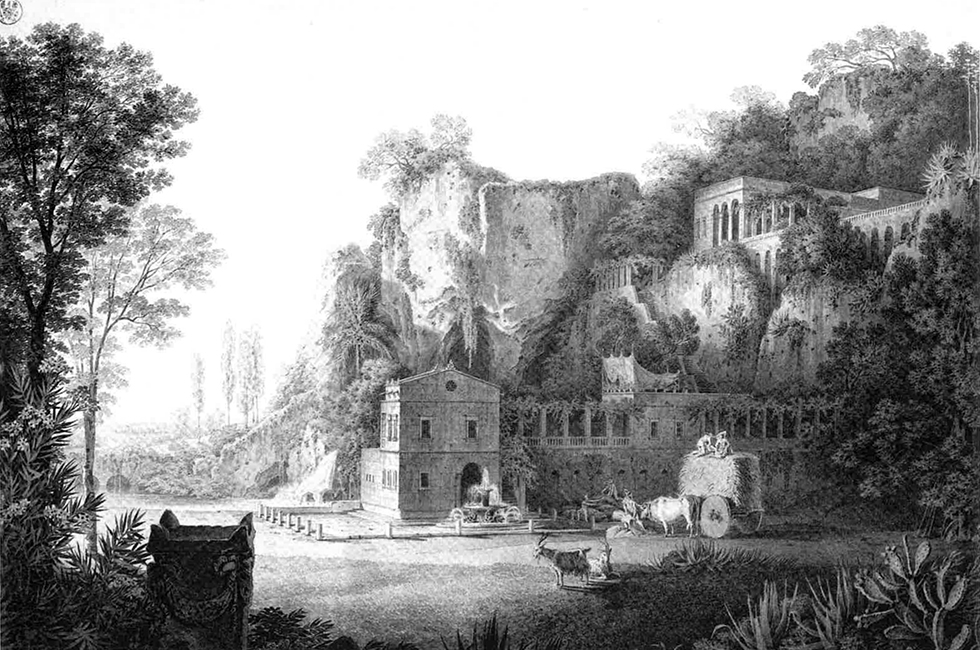
“The tools for changing the world are only given together with those for understanding it” (Calvino 1972: 197). The history of travel iconography is intertwined with that of architectural representation. The corpus of drawings produced by Schinkel during his stay in Sicily offers a unique synthesis of design process and territorial representation. Departing from the antiquarian interest and painterly inclination of other travellers, he travelled to Sicily in order to understand the effect of architecture within the landscape; all the drawings of the island may therefore be read as a continuous questioning of the integration between the built environment and the landscape, seeking lessons for contemporary design in the Sicilian experience. Schinkel’s drawings transform the built environment and the landscape, in their reciprocal interactions, into ideas of architecture. The synthesis of these ideas takes form in the Landhaus bei Syrakus, the first “Fragment” of the architectural treatise to which he devoted his entire life and which remained unfinished. The Lehrbuch was intended to comprise a series of plates dedicated to ‘most exemplary’ Italian constructions perfectly integrated into their landscape, in a relationship of mutual reinforcement: occasions for new ‘ideas of architecture.’ The incomplete nature of the Landhaus bei Syrakus enables the evolution of the thought underlying it into a new form of territorial representation, foundational to a method that translates into drawing a trans-scalar and transcultural way of observing reality, according to an explosion of scales that connects the single stone and the mountain. The Country House near Syracuse is a ‘resilient image’ insofar as it can prefigure new ideas, configuring itself as a transitional element from the construction of a treatise composed of fragments to the experimentation of a method: the triptych.
Downloads
Published
Issue
Section
License
Copyright (c) 2026 Laura Nunzia Ferlito, Graziano Testa

This work is licensed under a Creative Commons Attribution-ShareAlike 4.0 International License.