Techno-Aesthetic Exaptation: A Letter on Drawing from 2051
DOI:
https://doi.org/10.15168/xy.v11i17.4269Keywords:
heuristics, individuation, morphogenesisAbstract
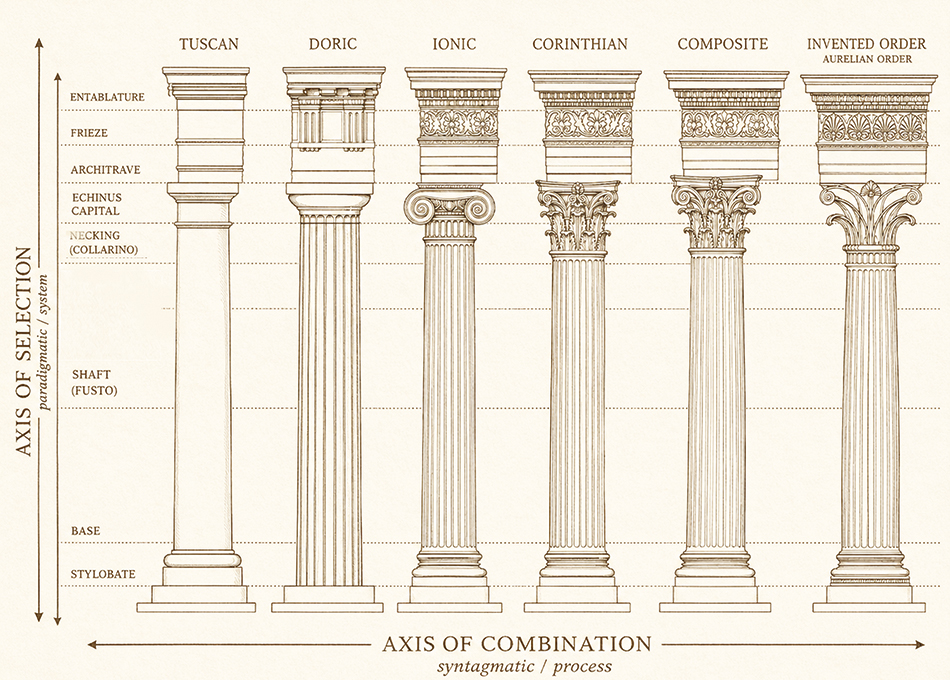
This essay considers how the evolutionary principle of ‘exaptation’ – understood as the co-option of pre-existing structures or properties within new functional systems – may be extended to the domain of techno-aesthetic artefacts and rendered amenable to operational modelling there. Its thesis is developed through a retrospective fiction set in 2051: the environmental, technical, and cultural changes described in §§ 0.0-0.3 outline systems in which forms, functions, and environments transform one another, while generative AI makes some of these relations increasingly open to exploration (§§ 0.4-0.5). To demonstrate that exaptation is also a principle of design (§ 1.0), the essay distinguishes the evolutionary mechanisms of Naturalia and Artificialia, whilst identifying in both a principle of relational co-option (§ 1.1). The central thesis (stated in § 1.2) translates this principle into an operational criterion by means of several categories of structural semiotics: ‘paradigm/syntagm’, ‘selection/combination’, and the ‘commutation test’. It argues, in other words, that by transferring and recombining a property within a new configuration, one may determine whether the variation produces a functionally pertinent difference. On the techno-aesthetic plane, the argument turns to Gilbert Simondon’s philosophy, locating the evolutionary dynamic in the principle of ‘concretisation’, whereby the technical object evolves through the progressive integration of formerly separate functions and properties (§ 2.1). Since this process entails the reciprocal ‘individuation’ of the object and its milieu associé (§ 2.2), the essay specifies how the object renders sensible the system of relations between form, function, and environment. The technical object may thus operate as an aesthetic prosthesis, and its aesthetic quality emerges when these relations become perceptible and intelligible (§ 2.3). A comparison with the diachronic change of ‘languages’ and the transformation of ‘styles’ then shows how visual forms and cultural traits, too, may persist beyond their original context, migrate, and acquire new pertinences (§ 3.0). Because AI models trained through deep learning themselves exhibit exaptive dynamics, they make processes of transfer, recombination, and refunctionalisation computationally explorable (§ 3.1). Finally, multimodality extends this same exaptive logic to intersemiotic (intermodal) translations, thereby redefining Drawing as a discipline capable of exploring, comparing, and testing new possibilities of exaptation (§ 3.2).
Downloads
Published
Issue
Section
License
Copyright (c) 2026 Fabrizio Gay

This work is licensed under a Creative Commons Attribution-ShareAlike 4.0 International License.